Philips Allura vs Azurion: Why upgrade?
Is upgrading from a Philips Allura to an Azurion worth it?
Philips Allura vs Azurion: Comparison Table
| Category | Philips Allura | Philips Azurion |
|---|---|---|
| Platform generation | Proven legacy Philips platform | Newer-generation Philips image-guided therapy platform |
| Workflow | Familiar, traditional workflow | Designed around modern workflow, standardization, and multi-workspot operation |
| Table-side control | More traditional control-room-dependent workflow | FlexVision Pro supports broader table-side application control |
| Procedure setup | Familiar protocols | ProcedureCards help standardize setup by procedure, physician, or department |
| Dose/image tools | Configuration-dependent | ClarityIQ, DoseWise tools, Zero Dose Positioning, and other modern dose-management capabilities depending on configuration |
| Advanced guidance | Configuration-dependent | Better aligned with SmartCT, 3D applications, and advanced Philips interventional tools |
| Long-term support | Mature platform | Stronger technology runway and upgrade pathway |
| Best fit | Shorter-term bridge, budget-sensitive use, teams already comfortable with Allura | Long-term modular lab, surgeon-driven programs, neuro/IR/vascular growth, premium procedural environment |
When comparing the Philips Allura vs Azurion, the question is not whether Allura can still perform. The Allura is a proven Philips platform that many physicians and technologists know very well.
The better question is:
If your team is choosing a lab for the next several years, which platform gives your team the best clinical workflow, staff experience, and long-term technology runway?
For most hospitals, the answer is the Philips Azurion.
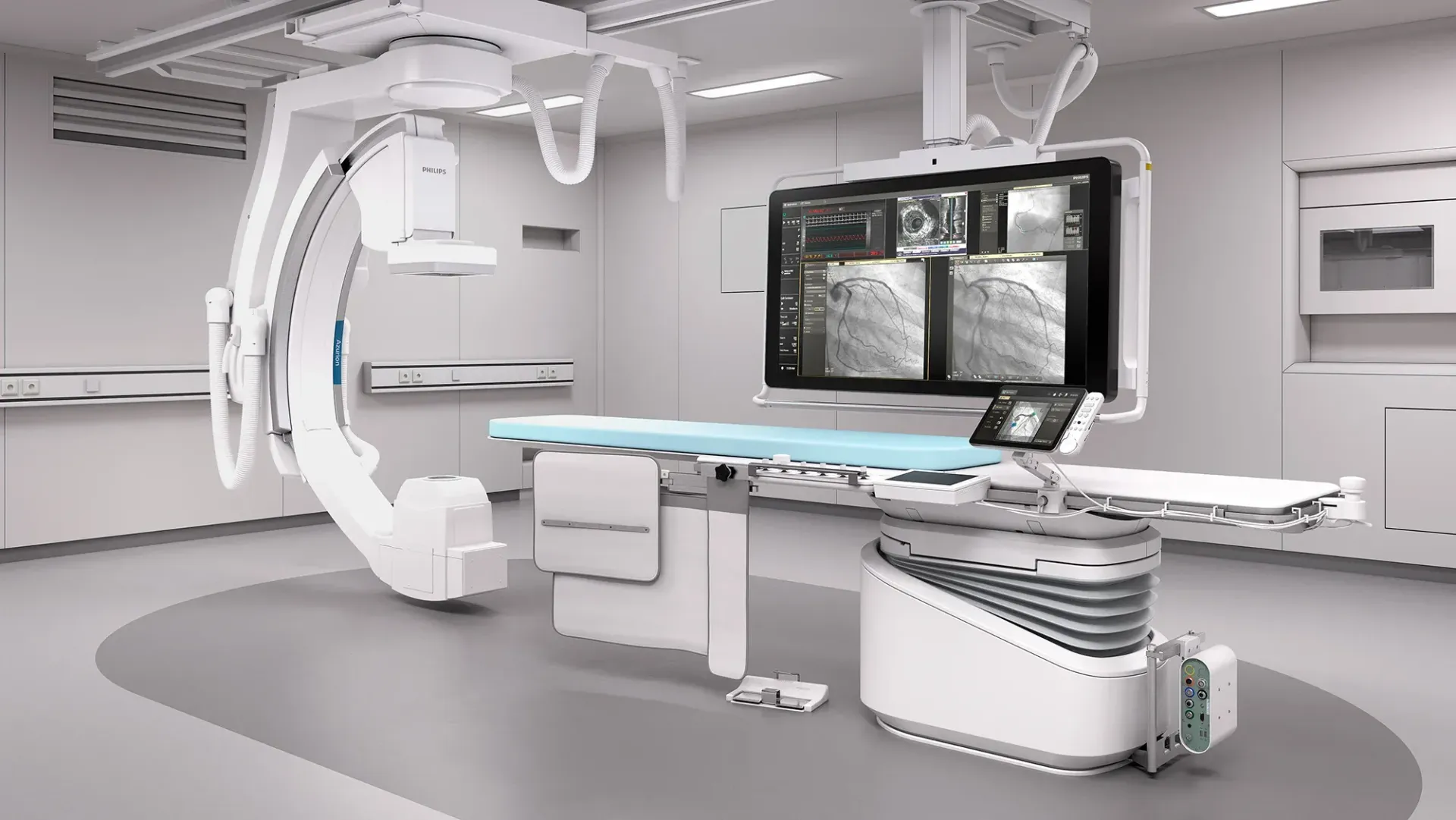
The Azurion is Philips’ newest-generation image-guided therapy platform. Philips describes Azurion as a system built to support both routine and complex interventional procedures, with advanced capabilities, innovative system geometry, and workflow tools designed to optimize lab performance.
Philips Allura vs Azurion: The Difference
The simplest way to compare the two platforms is:
The Philips Allura is a capable legacy platform.
The Philips Azurion is the more modern interventional platform built around workflow, integration, table-side control, dose management, and future flexibility.
These differences matter most when your lab is expected to support high-value procedural work for more than a short bridge period. A temporary lab can easily become part of a hospital’s procedural capacity for years. In that scenario, choosing the newer platform is not just a technology preference. It is a long-term clinical and operational decision.
Azurion Offers a More Modern User Experience
One of the biggest advantages of Azurion is the user experience. The Azurion 7 is powered by ConnectOS, a real-time multi-workspot technology designed specifically for the Azurion interventional suite. Philips also notes that intensive user testing guided the development process to make the system easier to use.
Image-guided procedures already create a demanding room environment. Physicians, technologists, nurses, anesthesia, and vendor reps all need to work together while managing imaging, devices, patient safety, and procedural flow.
A more intuitive platform can help reduce friction in the room. For surgeons and interventionalists, that can mean fewer workflow interruptions and a more confident procedural experience.
Azurion Improves Table-Side Control
A major Azurion advantage is table-side control.
Philips states that with FlexVision Pro, users can control applications from table side in the interventional lab. Philips specifically notes that this can reduce the need for team members to leave the sterile area and walk to the control room during procedures, which can save time and help avoid delays.
For physicians, this is one of the most tangible upgrades from older-generation systems.
In practical terms, better table-side control can support:
- faster adjustments during procedures
- fewer breaks in workflow
- less dependence on back-and-forth control room communication
- a more surgeon-directed room experience
- better continuity during complex cases
For a hospital trying to make a modular or temporary lab feel like a high-end procedural room, this is a meaningful point.
ProcedureCards Help Standardize Setups
Azurion also supports more consistent setup through ProcedureCards. Philips says the Azurion 7 uses ProcedureCards to help optimize and standardize system setup for routine and advanced procedures. These can include default protocols, commonly used settings, physician-level preferences, department-level settings, and uploaded hospital checklists or protocols.
This is important for any hospital with multiple surgeons or interventionalists using the same room.
A standardized setup helps reduce variation. It also helps staff prepare cases more consistently, which is especially valuable when the hospital is operating in a modular, mobile, or transitional environment.
Allura can still be familiar. But Azurion is built with modern standardization tools that better support multi-user procedural teams.
Azurion Has Stronger Dose-Management Positioning
Dose management is another major reason to favor Azurion.
The Azurion’s dose-management solutions are designed to support patient care, staff safety, and regulatory compliance. Philips also identifies features such as SpectraBeam filtration and Zero Dose Positioning, which allows users to prepare the next view using the Last Image Hold image without additional fluoroscopy.
Azurion also supports ClarityIQ, which Philips describes as combining advanced real-time image-processing algorithms with hardware to support visualization and dose-reduction capabilities. Philips reports demonstrated dose reductions of 67% in routine coronary procedures and 65% in routine neuro endovascular procedures compared with systems without ClarityIQ, while maintaining image quality; Philips also notes results vary by clinical task, patient size, anatomy, and clinical practice.
The sales takeaway is not “lower dose is guaranteed.” It is more precise:
Azurion gives hospitals access to Philips’ newer-generation dose and image-quality tools, which can be especially important for neuro, vascular, IR, and other image-guided procedures where case time and radiation exposure matter.
Azurion Supports Advanced Image Guidance
Azurion is also better aligned with advanced image-guidance workflows.
The Azurion biplane system is ideal for neuro interventions with SmartCT for 3D applications, intended to support confident decision-making. Philips also lists advanced interventional tools integrated into Azurion 7, including StentBoost, EchoNavigator, HeartNavigator, EP Navigator, OncoSuite, and XperCT, depending on configuration and availability.
That makes Azurion the stronger platform for hospitals thinking beyond a short-term replacement project.
If the lab will be used for neuro, IR, vascular, complex endovascular, or future outpatient interventional growth, Azurion gives the team a more modern platform.
Azurion Can Improve Lab Efficiency
In a busy procedural department, the lab is not just a room. It is a throughput engine.
The Azurion supports Instant Parallel Working, allowing team members to perform tasks in the exam room and control room at the same time without interrupting each other. For example, while fluoroscopy is taking place, a technologist in the control room can review prior images, prepare the next exam, or finish reporting on another patient. Philips describes this as supporting higher throughput and faster exam turnover without compromising quality of care.
This matters to administration as much as it matters to surgeons.
A newer system that supports smoother room turnover, fewer setup delays, and more efficient workflow can help the lab feel less like a temporary workaround and more like a true procedural asset.
Azurion Is Better for Long-Term Modular Lab Use
A hospital may initially view a modular biplane lab as a 1-year bridge. But in reality, these projects can extend. Construction delays happen. Service lines grow. Physicians adapt to the modular space. The “temporary” lab can become part of the hospital’s procedural strategy for several years.
That is where Azurion becomes much more compelling.
Philips states that the Azurion family is designed around a standardized hardware and software platform, with the ability to add new solutions and innovations as they evolve and integrate additional functionality and third-party applications as requirements change. Philips also notes that Technology Maximizer is included by default in every Azurion system and provides core software upgrades, training on upgraded functionality, and computer hardware replacement to support software upgrades.
For a long-term rental or modular deployment, platform upgrade path must be considered.
When Allura Still Makes Sense
Allura can still be a good option when:
- the rental is truly short term
- the hospital already uses Allura and wants minimal workflow change
- budget is the main decision driver
- the case mix is routine and does not require newer Azurion tools
- the hospital is treating the rental as a temporary bridge only
But if the hospital expects the lab to support surgeons for several years, the decision shifts.
The question becomes less:
“Can Allura get us through the project?"
And more:
“What platform do we want our physicians using if this lab becomes part of our long-term procedural capacity?”
That is where Azurion is the stronger answer.
Why Surgeons Prefer the Azurion
Surgeons and interventionalists tend to care about different things than procurement teams. They care about workflow, control, image confidence, visualization, case efficiency, and whether the lab feels like a real procedural environment.
The Azurion speaks directly to those concerns.
The major surgeon-facing advantages are:
- newer Philips platform
- more modern user interface
- better table-side control
- standardized procedure setup
- advanced image-guidance ecosystem
- strong dose-management tools
- better fit for neuro, IR, vascular, and complex image-guided work
- stronger long-term technology runway
For a surgeon, the Azurion argument is simple:
If you are going to spend years working in this lab, choose the platform that feels current, efficient, and built for where the service line is going.
Why Administration Should Consider Azurion
For hospital administration, the Azurion upgrade is not just about surgeon preference. It can also support:
Better long-term technology fit
If the modular lab remains in place for years, Azurion may be more appropriate for the life of the project.
Stronger surgeon adoption
Physician satisfaction matters. If surgeons prefer Azurion, the modular lab is more likely to be embraced.
Future-proofing the program
As interventional care evolves, newer platform capability and upgrade pathways become more important.
Avoiding midstream disruption
Upgrading later can create another round of planning, training, downtime, and internal approvals.
Strategic value
A modern Azurion biplane in a modular lab can position the hospital around advanced procedural capability rather than simply temporary coverage.
Final Takeaway: Azurion Wins for Long-Term Value
For a short-term, budget-sensitive bridge, Philips Allura can still be a practical solution.
But for a project that may support a hospital’s procedural program for years, the Philips Azurion is the better long-term choice.
Azurion gives hospitals a newer platform, stronger workflow tools, better table-side control, advanced image-guidance capability, modern dose-management features, and a stronger long-term technology runway.
In the Philips Allura vs Azurion decision, the best question is not just which system can perform the case tomorrow.
The better question is:
Which system will your physicians, staff, and administration still be happy with five years from now?
For most long-term biplane lab strategies, that answer is Azurion.

Sean Schneider
Mobile Project Manager · Atlas Medical
About the Author
Say hello to Sean Schneider - our Mobile Project Manager at Atlas Medical. Sean has worked in the medical imaging industry for over 20 years, including 10 years with Atlas Medical.
Sean has a knack for making complicated projects simple to understand. Around here, Sean's the man who keeps things moving smoothly.
When Sean isn't helping launch our mobile imaging units at new sites he enjoys spending time with his family, golf, and hockey.
Request a Mobile Imaging Solution
Our Services Include: