
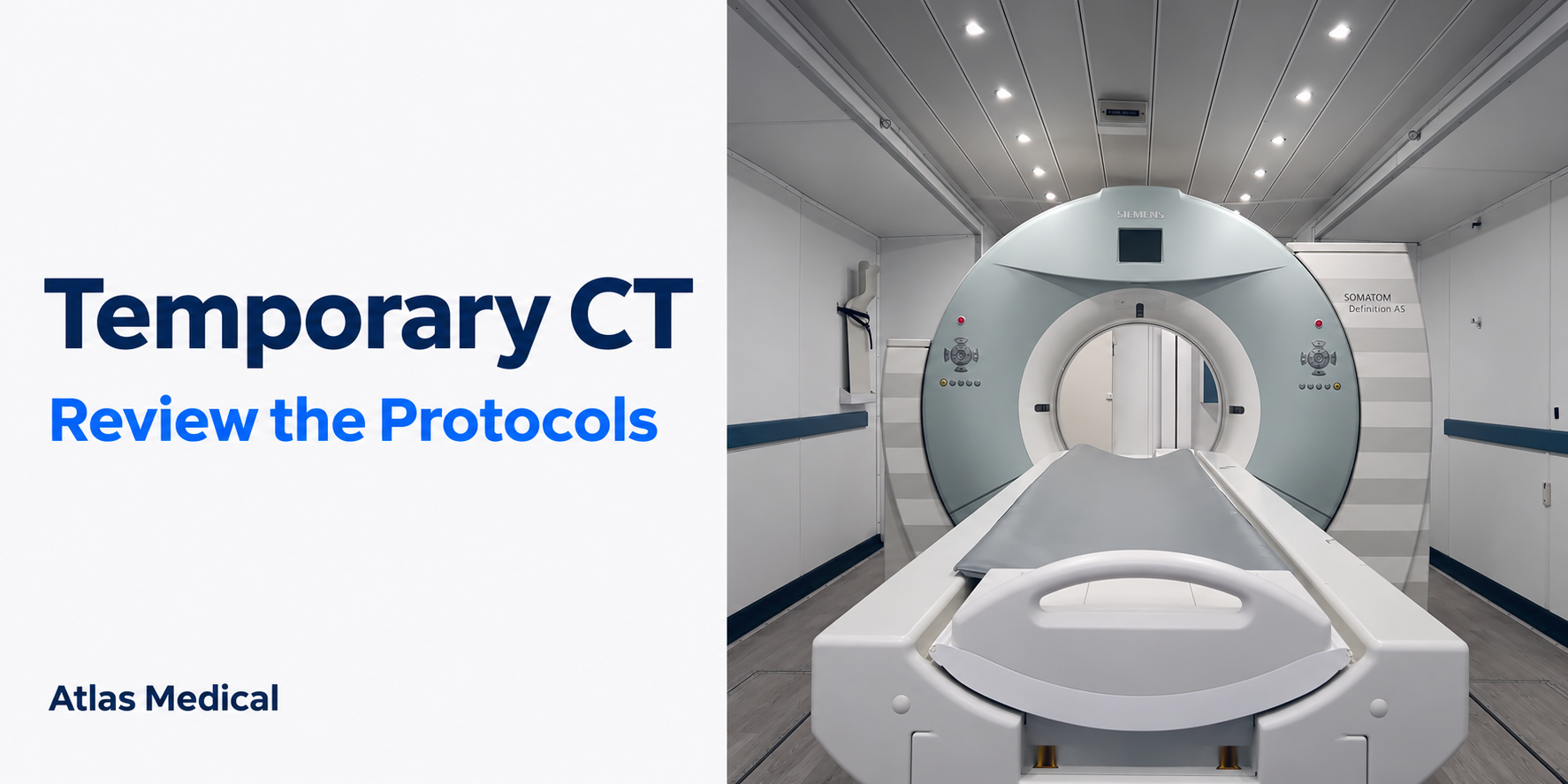
A hospital replacing its CT scanner may have a familiar examination menu, an experienced technologist team and a temporary unit selected. One decision still needs its own place in the transition plan: how will the hospital review and implement the protocols it intends to use on the assigned scanner?
The same examination name on two consoles does not establish that the underlying acquisition and reconstruction settings are the same. A project plan that treats protocol transfer as a file-copy task can leave important questions unresolved until the permanent scanner is already unavailable.
For a temporary CT project, the practical goal is to give the hospital's responsible clinical team time to review the actual configuration and decide what is ready for its intended service. This article addresses project preparation, not scan settings or patient-specific clinical decisions.
Separate scanner selection from protocol acceptance
Selecting a scanner answers a procurement question. Accepting a set of protocols answers a different clinical question. Keep both visible in the project schedule.
The AAPM CT protocol-management guideline describes protocol management as review, implementation and verification. It also recognizes the difficulty of maintaining protocols across different scanners. That supports a useful planning distinction: obtaining protocol information is an input to the review, rather than proof that the proposed protocols have been accepted.
Ask which examinations the hospital expects to move first, which remain outside the temporary service's scope and which require additional review. A narrower, defined starting scope is easier to discuss than a general instruction to make the temporary scanner match everything in the department.
Give the review team the assigned configuration
The people reviewing protocols need information about the scanner actually proposed for the project. Bring the model, software version and confirmed installed applications into the discussion. Identify information still awaiting confirmation rather than filling the gap with assumptions about the product family.
AAPM's CT protocol resources emphasize collaboration among radiologists, technologists and qualified medical physicists. Those resources also describe the physicist's role in equipment planning and protocol configuration. The hospital should identify its responsible participants early enough for their work to influence the transition schedule.
For project coordination, ask who will supply the scanner information, who will provide the hospital's current protocol references and who will arrange access for review. The rental coordinator can assemble those inputs; the hospital's clinical professionals determine whether the proposed implementation is appropriate.
Compare the clinical intent before comparing names
An examination label is useful for communication, but it is a poor substitute for a complete review. The planning discussion should identify the clinical purpose of the examination and the information the responsible team needs to evaluate its implementation on the temporary scanner.
For example, a hospital might use a familiar local name for a routine examination while the temporary console organizes that examination differently. The team needs an agreed way to connect the hospital's request with the reviewed console selection. This is a hypothetical coordination example, not a statement about a particular Atlas scanner or hospital.
Avoid asking project staff to translate technical settings themselves. Questions about acquisition, reconstruction, contrast-related workflow and image quality belong with the appropriate clinical and technical professionals. No numerical settings or interchangeability claims can be established from a marketing photograph or model name.
Put review dependencies ahead of the shutdown
Work backward from the date the permanent scanner is expected to become unavailable. Identify when the assigned configuration will be confirmed, when the hospital can review the proposed implementation and when staff preparation can occur.
These activities may involve different people and access requirements. An applications session, for example, can be useful for understanding the console, but the hospital still needs to identify who accepts the protocols for clinical use. A calendar entry labelled training should not silently stand in for every outstanding clinical review.
If one planned examination remains unresolved, record that specific limitation and its decision owner. Ask the hospital how it affects the proposed transition rather than presenting the whole service as ready because other project tasks are complete. Keep equipment delivery, technical testing, staff preparation and clinical acceptance as separate milestones with clearly described relationships.
Define the evidence the hospital wants to retain
Before the review begins, ask what the hospital requires to document its decision. Useful project questions include which protocol list or reference version is under review, how the installed implementation will be identified and where the hospital will retain the resulting acceptance record.
The project team does not need patient records in a general marketing or logistics folder. Clinical review material should remain within the hospital's authorized systems and procedures. General project correspondence can record that a review is pending or complete, identify the responsible person and reference the appropriate controlled document without circulating clinical data.
If the scanner assignment or configuration changes, bring that change back to the review owner. Do not assume that an earlier acceptance automatically covers a different system. The hospital determines the review needed for the revised arrangement.
Start the temporary CT discussion with a defined exam scope
For an initial project conversation, bring the intended examination scope, planned shutdown date, available scanner information and the hospital contacts responsible for protocol review. Identify what must be resolved before the transition decision can be made.
This gives equipment coordination and clinical preparation a common starting point while keeping their responsibilities clear. Planning a temporary CT service during renovation or replacement? Contact Atlas Medical to discuss the project and the assigned-unit information your hospital team needs for its review.